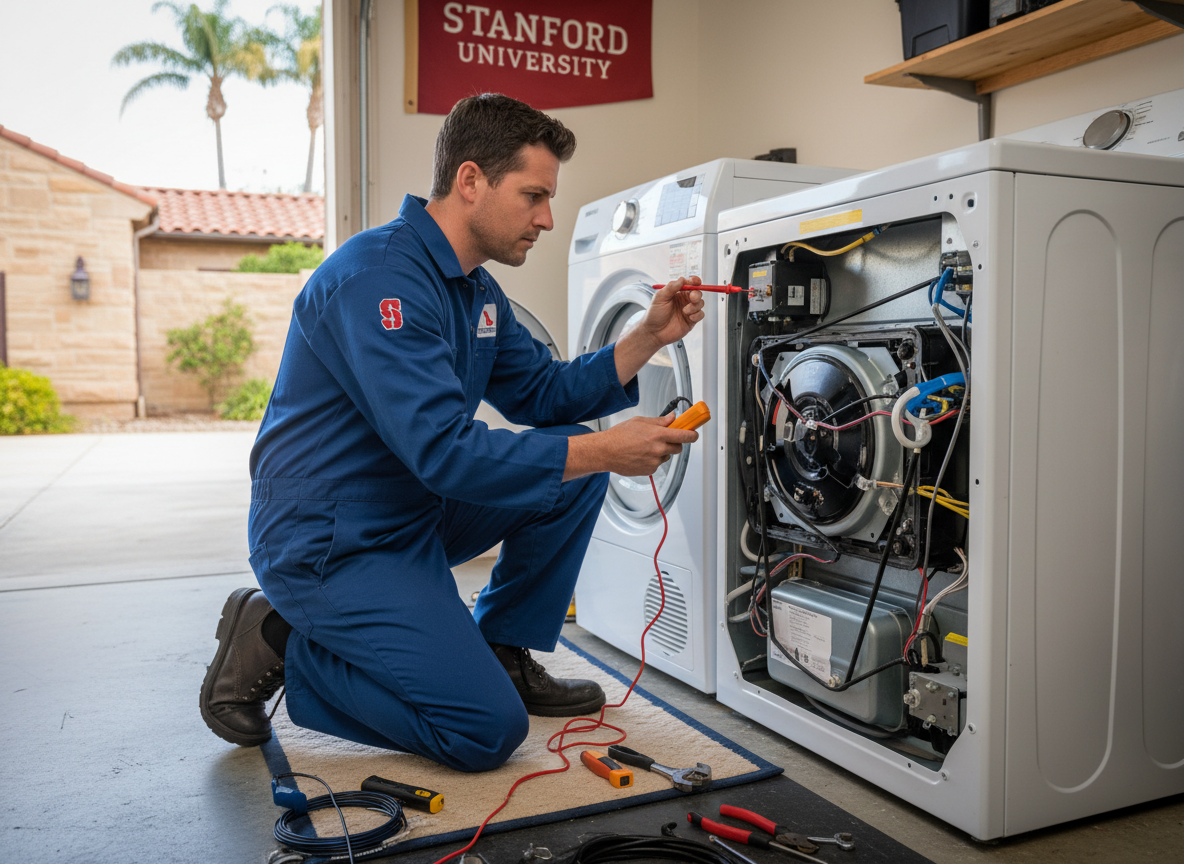
Stanford homes near the university campus and Hoover Tower often feature older construction with shared or extended dryer vents that run through walls or attics. In the mild Mediterranean climate, lint still accumulates steadily because residents run dryers year-round without the heavy seasonal drying that colder regions see. Technicians frequently find restricted airflow from debris buildup combined with aging flexible venting that cracks over time, forcing motors to overheat and fail prematurely.
Santa Clara County properties close to Stanford Stadium and campus housing stock commonly have 220-volt circuits installed decades ago that now show worn terminals or undersized wiring when paired with modern high-efficiency dryers. Moisture from the bay area’s occasional fog can also promote corrosion on heating elements and thermostats inside the machine. Repair work here requires checking both the appliance and the full vent path to the exterior to avoid repeat failures that leave students or faculty without working units during busy academic periods.
Technicians working in Menlo Park and Palo Alto neighborhoods routinely encounter stacked washer-dryer units in tight utility closets where poor clearance restricts exhaust. This setup, common in townhomes near campus, turns minor lint clogs into safety issues faster than in single-family homes with dedicated laundry rooms. Proper repair includes verifying that the vent termination clears the roofline or side wall by the required distance to prevent re-entry of moist air into living spaces.
Technician insight
In Stanford the thing that catches most people out with dryer repair is the long, shared vent runs in campus-adjacent apartments that were never designed for today’s high-volume loads. The mild climate means residents forget to check exterior flaps until the motor is already straining, and those older 220 circuits near Hoover Tower often need terminal cleaning before any new part will last.
Restricted vent in a Palo Alto duplex near campus
A dryer in a Menlo Park duplex kept shutting off after ten minutes. Inspection showed the vent pipe ran through an attic with two crushed sections and heavy lint from years of use. The technician replaced the damaged sections, cleared the line to the exterior, and installed a new heating element that had failed from the restricted airflow. The unit now completes full cycles without overheating.
Dryer Repair Services We Offer
✓Heating Element Replacement
Swap out failed electric heating elements that no longer reach proper temperature due to age or power fluctuations common in older Stanford campus-area homes.
✓Dryer Vent Cleaning
Remove lint buildup from the full vent run to the exterior, reducing fire risk and restoring airflow in homes near Hoover Tower and Stanford Stadium.
✓Drum Roller and Belt Repair
Replace worn rollers, idler pulleys, and drive belts that cause squealing or slow tumbling in dryers used heavily by Stanford University residents.
✓Thermostat and Sensor Replacement
Install new high-limit thermostats and moisture sensors that shut down the dryer prematurely in mild Santa Clara County weather conditions.
✓Gas Dryer Conversion and Repair
Service gas models and perform safe conversions when homeowners switch units in Palo Alto and Menlo Park properties with updated utility lines.
Dryer Repair Cost in Stanford, CA
| Service | Typical Range | What Affects It |
|---|---|---|
| Diagnostic visit | $95–$150 | Waived if repair is approved on site |
| Heating element replacement | $180–$320 | Varies by model and access in tight campus closets |
| Full vent cleaning | $150–$275 | Depends on length and number of turns in older homes |
| Drum roller and belt service | $220–$380 | Includes parts for most standard units |
Ranges are typical for Stanford, CA and confirmed with an exact written quote before any work starts.
How it works
- 1
Initial Assessment
Technician arrives and runs the dryer through a full cycle while checking temperature, airflow, and unusual noises at the Stanford location.
- 2
Vent And Connection Inspection
Full exterior vent path is examined for blockages, crushed sections, or improper materials common in campus-area housing.
- 3
Component Testing
Heating elements, thermostats, rollers, and belts are tested with multimeter and visual inspection for wear.
- 4
Repair And Verification
Parts are replaced as needed, vent is cleared, and the unit is run again to confirm safe operation before departure.
Pricing
Upfront quotes given after diagnosis with no hidden fees for Stanford service calls.